Bisherige Projekte und Referenzen
GA Synopta verfügt über langjährige Erfahrung in der Entwicklung von Systemen mit adaptiver Optik für den Einsatz in der optischen Satelliten-Boden-Kommunikation, wie z.B.
- Cassegrain Adaptive Receive Optics (CARO), 1050-1080 nm and 1530-1570 nm; verfügbar für die ESA Optical Ground Station (OGS), Teneriffa, Spanien (Fig. 1) [1];
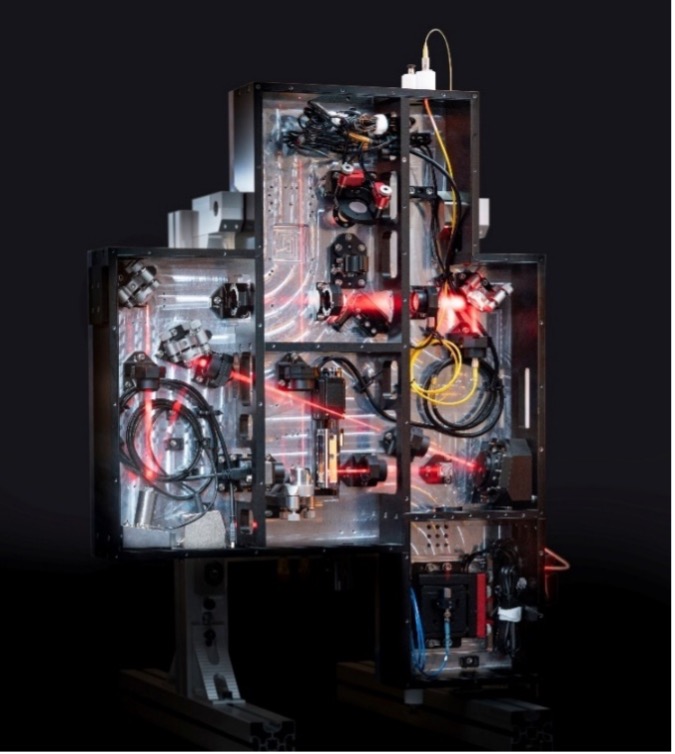
- Quantum Communication Adaptive Optics (QCAO) Box, 670-1000 nm, ausgeliefert an das Institute for Quantum Optics and Quantum Information (IQOQI), Wien, Österreich (Fig. 2) [2];
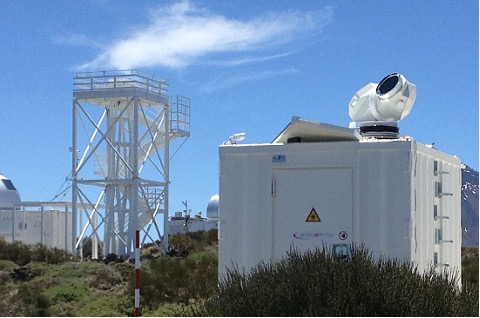
- Transportable Adaptive Optics Ground Station (T-AOGS), 1064 nm, im Besitz des DLR und betrieben von TESAT Spacecom (Fig. 3 ) [3];
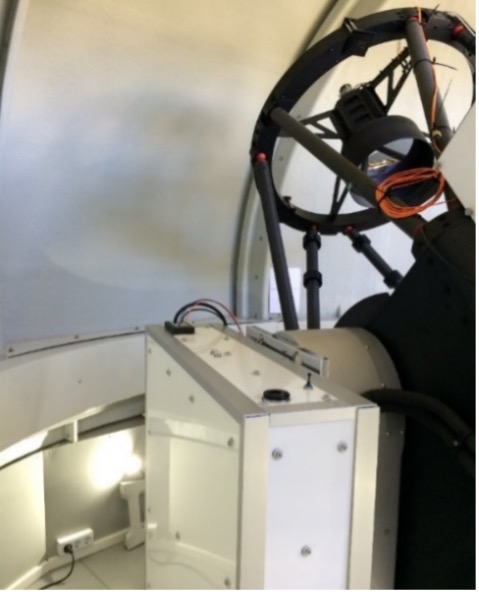
- Acquisition and Tracking Subsystem, Technologie-Testplattform zur Reduzierung von Weltraummüll, geliefert an ESAs IZN-1 auf Teneriffa, Spanien (Fig. 4 ) [4].
- Alpha-Up and Down Experiment (AUDE) Breadboard, weltweit erste Demonstration einer verbesserten Uplink-Leistung zu GEO durch Vorkompensation der Wellenfront des Uplink-Strahls anhand von Messungen der Downlink-Wellenfront; bidirektional (1064 / 1075 nm), ohne Laser Guide Star; verfügbar an der ESA OGS, Teneriffa, Spanien [5, 6];
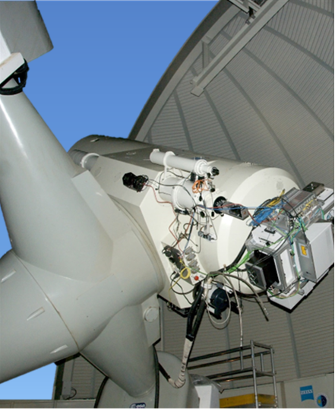
1 m Teleskop der ESA OGS
Referenzen:
[1] E. Fischer, K. Kudielka, T. Berkefeld, et al. "Adaptive optics upgrades for laser communications to the
ESA optical ground station", Proc. SPIE 11852, International Conference on Space Optics — ICSO 2020,
118522A (11 Jun 2021); https://doi.org/10.1117/12.2599370
[2] E. Fischer, K. Kudielka, A. Brady, et al. "Modular adaptive optics solution for a QKD receiver on a fork
mount telescope system", Proc. SPIE 11852, International Conference on Space Optics — ICSO 2020,
118520X (11 Jun 2021); https://doi.org/10.1117/12.2599216
[3] E. Fischer, Th. Berkefeld, Mikael Feriencik, et al. "Use of adaptive optics in ground stations for high data
rate satellite-to-ground links", Proc. SPIE 10562, International Conference on Space Optics — ICSO
2016, 105623L (25 Sept 2017); https://doi.org/10.1117/12.2296200
[4] Di Mira, Andrea & Fischer, Edgar & Kudielka, Klaus & Nussbaum, Max & Klodt, Lukas & Heese,
Clemens. (2023). “Optical Communication with the IZN-1 Robotic Optical Ground Station”. 2022 9th
International Workshop on Tracking, Telemetry and Command Systems for Space Applications (TT&C).
ESA/ESTEC, Noordwijk, The Netherlands.
[5] Klaus Kudielka, Edgar Fischer, Thomas Berkefeld, Christoph Fischer, Monika Neuweiler, et al..
Successful first optical feeder link demonstration between a ground station and a GEO satellite applying
adaptive optics pre-compensation ("Alpha-Up"). COAT2023, Mar 2023, Durham, United Kingdom.
⟨10.34693/COAT2023-014⟩. ⟨hal-04605018⟩
[6] Aaron Buckner, Klaus Kudielka, Edgar Fischer, et al. "Up- and down- link atmospheric compensation
experiment with Alphasat: design and initial results", Proc. SPIE 13355, Free-Space Laser
Communications XXXVII, 1335516 (19 Mar 2025); https://doi.org/10.1117/12.3041292