Press Releases & Reports

Deep-Space Optical Communication
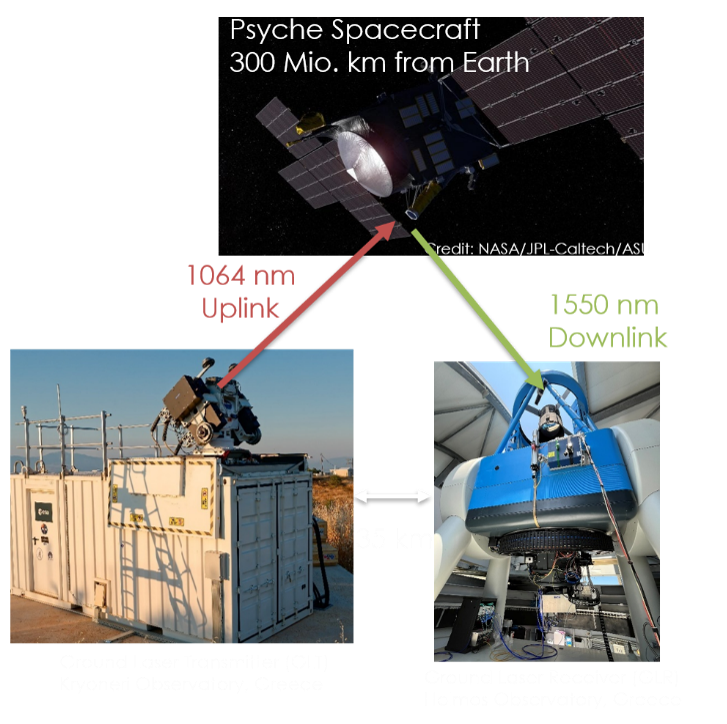
By the fourth and final link, the team had passed the two-astronomical-unit distance threshold, successfully receiving a data transmission at speeds of up to 1.8 Mbps [2]. The bidirectional deep-space to ground link consisted of the following systems:
- Ground Laser Receiver (GLR) - Downlink: 1550 nm wavelength source, received via the Adaptive Receive Optical Bench mounted on the 2.2 m Aristarchos telescope at the Helmos Observatory, Greece [3, 4]
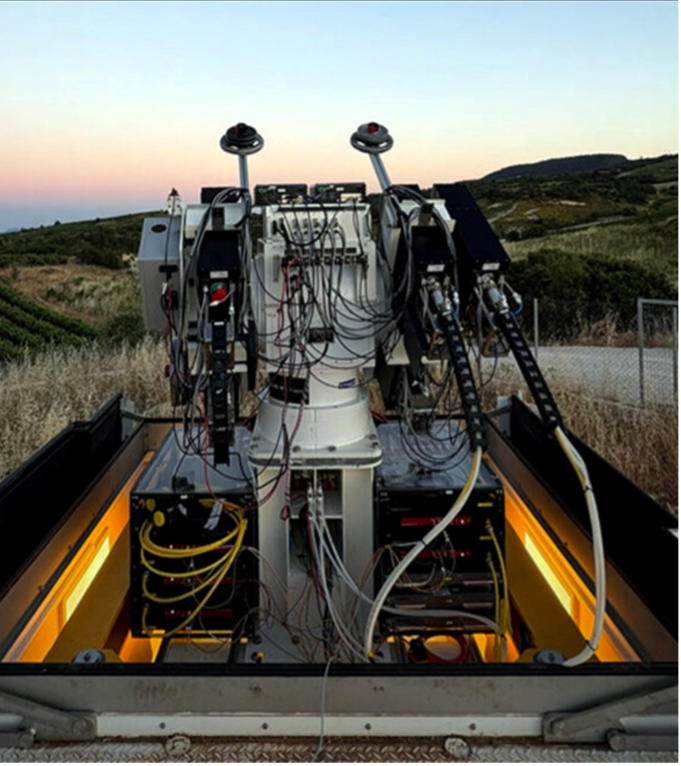
- Ground Laser Transmitter (GLT) - Uplink: 1064 nm wavelength source, transmitted via the ULTIMA Ground Multi-Beam system – 4 kW power (50% duty cycle modulation) - operated from the Kryoneri Observatory, Greece [5].
This achievement was delivered through a consortium of European companies including GA Synopta (CH), qtlabs (AT), Single Quantum (NL), qssys (DE), Safran Data Systems (FR) and Hamamatsu Photonics K.K (JP), in partnership with the National Observatory of Athens, and lays the groundwork for ESA's proposed ASSIGN (Advancing Solar System Internet and GrouNd) programme [2].
![The Deep Space Optical Communications experiment onboard Psyche captures ESA's signal [1].
Credit NASA/JPL-Caltech](../images/news/thedeep.gif)
![Uplink 1064 nm Transmitters [2]](../images/news/uplink.gif)

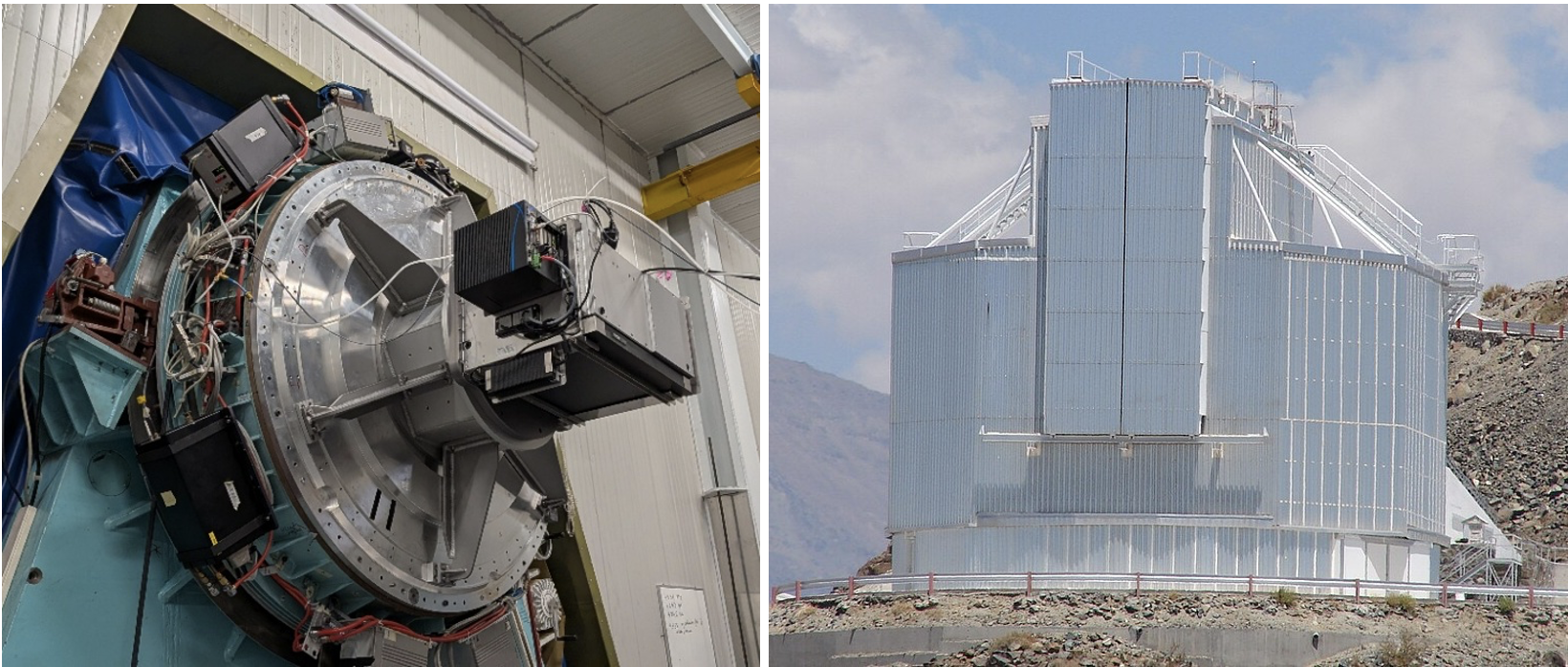
A follow-on activity with ESA was completed to adapt the GLR technology to the 3.6 m New Technology Telescope (NTT) in La Silla, Chile (ALGOS DSOC, ESA AO/1-12073/24/D/MB). A survey of, and trade-off between eight large telescopes has been performed. ESO’s NTT has been selected for the demonstration, that ESA’s GLR can be adapted to telescopes larger than the Aristarchos telescope. A GLR Adapter and a GLR Emulator have been designed, manufactured, and tested, to validate all interfaces between the NTT and a potentially upgraded GLR. During the on-site test campaign in March 2026, all interfaces (optical, mechanical, electrical, software) have been successfully validated. Acquisition / coarse tracking of solar system objects with 1 arcsec accuracy has been demonstrated, making use of the Telescope Control System. The GLR Adapter and GLR Emulator mounted to the Nasmyth B port of the NTT are shown below.
References:
[1] European Space Agency. “Europe's first deep-space optical communication link” (10 July 2025).
https://www.esa.int/Enabling_Support/Operations/Europe_s_first_deep-
space_optical_communication_link
[2] European Space Agency. “ESA wraps up 300-million-kilometre optical communication campaign”
(27 August 2025).
https://www.esa.int/Enabling_Support/Operations/ESA_wraps_up_300-million-
kilometre_optical_communication_campaign
[3] Johannes Pseiner, Lukas Bulla, Johannes Handsteiner, Edgar Fischer, Klaus Kudielka, Christoph Fischer
et al. "Deep-space optical communication telescope for ESA’s ground laser receiver for ESA/NASA
Psyche deep space optical communication demonstration", Proc. SPIE 13699, International Conference
on Space Optics — ICSO 2024, 136993L (28 Jul 2025); https://doi.org/10.1117/12.3075377
[4] C. Fischer et al., “Ground Laser Receiver for Deep Space Optical Communication”, 10th International
Workshop on Tracking, Telemetry and Command for Space, 25-28 November 2025, ESA-ESOC,
Darmstadt.
[5] Michael J. Yarrow, Christoph Fischer, Aaron Buckner, Klaus Kudielka, Edgar Fischer et al. "Ground laser
transmitter for ESA’s deep-space link with NASA’s Psyche spacecraft", Proc. SPIE 13885, Free-Space
Laser Communications XXXVIII, 138850Y (5 Mar 2026); https://doi.org/10.1117/12.3087136